|
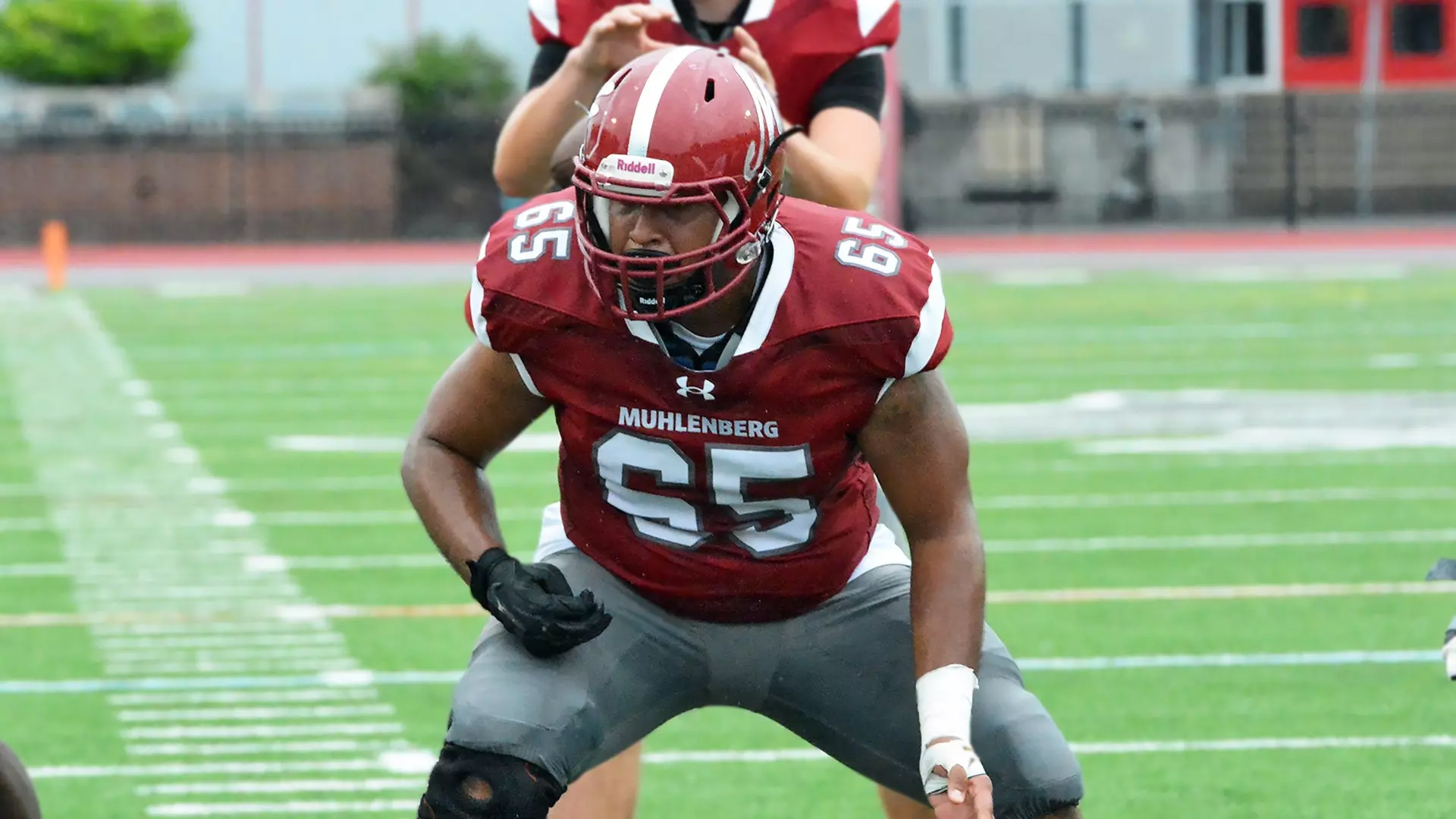
| Robert Terreros has had to battle his way through injuries as well as wait out the double senior class that was ahead of him before he could become Muhlenberg's starting center. Muhlenberg athletics photo |
By Greg Thomas
D3football.com
When the moment arrived, Muhlenberg didn’t flinch.
Early in the second quarter against Carnegie Mellon, the Mules turned to sophomore quarterback Luke Spang. The sophomore had shared snaps early in the season but spent the last few weeks watching from the sideline as Dante Mahaffey settled into the starting role. By the time the third quarter ended, Muhlenberg trailed by 16, but there was no panic in Spang’s huddle and no hint of doubt as he stepped in against one of Division III’s stingiest defenses.
By the time the clock ran out, Muhlenberg had scored 20 fourth-quarter points and rallied to earn a 27-23 win. It wasn’t just another comeback. To the program, it was another statement about who this team is.
As it so often does, this weekend’s matchup between Muhlenberg and Johns Hopkins will have major implications in the Centennial Conference race. But this time, the Mules’ push toward the top isn’t being led by familiar names or record-setting quarterbacks. It’s being powered by players who have waited, watched, and worked for years to finally take their turn.
For most of the past decade, Muhlenberg’s program has been synonymous with continuity. From Nick Palladino to Michael Hnatkowsky to Joe Repetti, the Mules have enjoyed a run of elite quarterback play that filled the record book and carried them deep into the postseason. Stability under center mirrored the roster as a whole: a veteran core, a steady system, and a coaching staff that churned out playoff teams like clockwork.
That stability eventually created its own challenge. The COVID-19 eligibility bubble stretched careers, stacked depth charts, and left a full recruiting cycle of players waiting behind double senior classes.
Right now in Division III, the post-COVID eligibility ripple effect is one of the most quietly consequential storylines. “All of us as coaches looked at our rosters and realized, oh man, there are a lot of new kids,” Muhlenberg head coach Nate Milne said. “Then you look at your opponent’s two-deep and say, I don’t recognize any of those names either. There’s a give and take with that.”
The turnover was dramatic. Ten offensive starters from last year’s season-ending bowl win were part of that double senior class, along with six of the top eight defensive linemen. For the first time in years, the Mules weren’t defined by who they returned, but by who was ready next.
“We had a pretty stacked two or three deep because of the fifth-year situation,” said senior defensive lineman and co-captain Blaze Curry. “Obviously we lost a lot of really good football players, but it wasn’t like we were taking a big hit. The guys underneath them have been working and hungry for those three years they’ve been waiting their turn.”
For seniors like left tackle Michael Powel, safety George Europe, and center Robert Terreros, that hunger has finally met opportunity.
“All of us as coaches looked at our rosters and realized, oh man, there are a lot of new kids. Then you look at your opponent’s two-deep and say, I don’t recognize any of those names either."– Muhlenberg football coach Nate Milne |
Powel’s story mirrors that of many veterans on this Muhlenberg team, shaped by years of waiting and by the leaders he learned from along the way.
“Coming here as a freshman, I knew getting playing time at Muhlenberg would be hard for anybody,” Powel said. “I was bouncing around positions and eventually found my way to tackle. My freshman and sophomore years, I was backing up Zach Greenberg, who’s now the starting center at James Madison. There’s not much I could do other than just be a sponge, as my dad always says, and take everything he did and try to replicate it.”
Terreros’s wait came with a tougher price. He suffered a season-ending injury three days before the 2023 opener, then another in the third game of 2024. Only now, in his senior year, is he finally healthy enough to anchor the offensive line.
“Battling these injuries has just made me stronger and grateful to have the opportunity to play my senior year,” Terreros said.
Europe, now a starting safety, spent his early seasons learning from one of the best defensive back groups in program history.
“It was definitely tough,” Europe said, “but those fifth-years I worked with my freshman year were amazing. John Washington was a great defensive back and taught me so much. I believed in the process, stayed patient, and trusted that the right time would come.”
Milne credits that patience, and Muhlenberg’s developmental model, for keeping the program’s standard high through waves of roster turnover.
“You have really good players waiting in the wings,” Milne said. “We’ve traditionally done a good job with personnel. Our defense will have four or five different personnel groups, and we try to get guys a handful of reps in a game and another handful of reps in the next game. By the end of a season, they’ve played 80 or 90 snaps even if they weren’t the starter.”
In a sport that moves on quickly, these seniors are proof that development still matters and that four-year players can be difference makers in Year 4.
Spang’s moment against Carnegie Mellon fit neatly into that theme of readiness.
“Dante and I have a really close relationship,” Spang said. “Throughout the week we’re talking through stuff, plays we like and don’t like, staying plugged in with the coaches. But at the end of the day, it’s just football. When I got in, it wasn’t about how much preparation I did or anything like that. It was just going out there and having fun.”
Milne saw that attitude translate immediately. “I do think that we don't win that game unless we had played Luke Spang earlier in the season. If he didn't get 20 snaps at Endicott on the road or in a big game Friday night against Moravian in our rivalry game with a trophy on the line,” Milne said.
“When he came into the game, I was calling plays as if he was the man the whole time, because I had already done that earlier in the season. When you're at Endicott and, and he's in the game, you're not calling plays for Luke Spang or Dante Mahaffey, you're calling the plays that need to be called,” Milne explained. “And the same was true here on Saturday. I was calling all the game plan plays and calling things that we needed to do to beat a really good defense in Carnegie Mellon. And he executed as if he was the starter the whole time.”
That composure extends beyond the quarterback room. Curry, one of the few returning starters from the previous defense, sees it throughout the locker room.
“One of the reasons we’re doing so well is that everybody who’s a senior and even a junior is voicing their opinion and leading by example,” he said. “They’re showing the freshmen and sophomores how this culture is really different.”
Muhlenberg’s culture has been the backbone of the success of this year’s team. It’s not flashy, and it doesn’t rely on transfers or short-term solutions. It’s built on trust between coaches and players, between classes, and between eras.
“We’ve recruited the right players,” Milne said. “They want to stay in our program, learn from the upperclassmen, and they don’t resent those guys for playing or staying. Everybody understood what happened during the pandemic with that extra year.”
Powel sees that connection from class to class as the constant that binds every Muhlenberg team. “We always follow our core standards- Dig In, One Heartbeat, and Championship Climb,” he said. “It’s been that way every year I’ve been here and every year Coach Milne’s been here. The difference is we don’t just say it or wear it on a shirt; we live it every day.”
The Mules’ success may look like it came overnight for some of these seniors, but these Mules know better. This has been years in the making. Now, their time has arrived and the timing couldn’t be better.
“It’s an amazing feeling being one of the two seniors starting on the offensive line with Michael,” Terreros said. “The younger guys look up to us as leaders. They try to take bits and pieces from our experiences. This season has been really hard and really good at the same time.”
The Mules’ comeback win over Carnegie Mellon provided validation. The showdown with Johns Hopkins will provide measurement. While CMU is still the Centennial’s new kid on the block, either Muhlenberg or Johns Hopkins has claimed at least a share of the conference title in all but one season since 2007. It’s the rivalry that defines the league and more often than not unlocks the path to the postseason.
Nobody in this locker room is taking that opportunity for granted.
For the players who waited through injuries, depth charts, and a global pause, this isn’t just another big game. It’s the moment they spent years preparing to reach.
Post-COVID Postscript
Every team in Division III has felt the effects of the COVID eligibility waiver in some way. It gave programs an extra year of continuity and let a lot of veterans write longer stories. But now that the wave of super seniors has finally passed, we’re seeing the other side of it in the group of players whose careers got stuck in the overlap.
At Muhlenberg, safety George Europe called it “two sophomore years.” His class showed up just as the rosters were packed with fifth- and sixth-year guys, and for a lot of players across Division III, that meant waiting longer than usual for a real opportunity. Juniors who might have been ready to break through were still stuck behind seniors, grad students, and the remnants of the extra-year era.
Those players, the class of 2026 in particular, have quietly carried a big share of the load these past couple of seasons. They’ve done the lifting, the practicing, the scout-team grinding, without much of the spotlight. And now, as the roster logjam finally clears, they’re the ones stepping forward. It’s a reminder that in Division III, where nobody gets fast-tracked, patience still counts as a skill and some of these guys have been practicing it longer than anyone.
Seven ways to Saturday
Whether you need to recap the week that was or get ready for the week to come, D3football.com is your daily source for fresh Division III football content. We’re bringing the content seven ways to Saturday.
- Sunday: New Top 25 poll
- Monday: Around The Nation podcast. Patrick Coleman and Greg Thomas recap the weekend that was and preview the weekend to come in Division III football.
- Tuesday: Team of the Week Honors
- Wednesday: Features columns
- Thursday: Around the Nation Column
- Friday: Quick Hits featuring our panel’s predictions and insights into the weekend’s games
- Saturday: Game Day! The D3football.com Scoreboard has all of your links for stats and broadcasts.
I’d Like to Thank ...
Special thanks to Muhlenberg’s George Europe, Michael Powel, Luke Spang, Blaze Curry, Robert Terreros, and Nate Milne for spending time with Around The Nation for this week’s column. Additional thanks to Mike Falk, Sports Information Director at Muhlenberg College for coordinating this week’s conversations!
Read options?
There’s nothing small about small college football. Division III is home to 241 teams, and many thousands of student-athletes and coaches. There are so many more stories out there than I can find on my own. Please share your stories that make Division III football so special for all of us! Reach out to me at greg.thomas@d3sports.com, on X @wallywabash, or on Bluesky @d3greg.bsky.social to share your stories.


